Not Logged In
You need to be logged in, be a member, and get a ticket to attend this session.
Presentation Virtual exchange & COIL
When Virtual Collaboration Prevails and Fails
This presentation examines where digital tools succeeded and failed in facilitating a COIL program. Reflective reports from 40 students across three Japanese universities (n=23), one German university (n=10), and one Ukrainian university (n=7) were thematically analyzed. This was part of a broader COIL project including additional Japanese universities and institutions in Indonesia and the Philippines. Students collaborated via Zoom, social media (WhatsApp, Instagram), and Google Docs. Despite virtual interaction, the majority demonstrated measurable intercultural growth using Bennett's DMIS framework, with technology enabling participation. However, some struggled with asynchronous platforms, experiencing failed group chats, coordination gaps, and reduced emotional connection compared to in-person interaction. Almost all students identified English proficiency as the primary barrier, but manifestations of this barrier varied across cultures in technology-mediated contexts. Ukrainian students transformed fear of imperfect digital English into confident expression. Japanese students’ high-context communication norms clashed with direct digital communication, yet similarly, they developed English confidence. German students navigated between their low-context directness and accommodating partners from high-context cultures, demonstrating adaptive strategies. This study argues that digital COIL design must address how cultural patterns intersect with providing differentiated support and platforms, while recognizing that CALL competence encompasses cultural-technological adaptation alongside linguistic proficiency.
-

I received my Ph.D. in Transformative Education from Osaka University. I am currently an assistant professor at Doshisha Women's College of Liberal Arts. I am also the ICLHE RG&SIG coordinator, and EliPro Japan's EMI&GE coordinator. My research interests include English-Medium Instruction (EMI) student support, Global Englishes (GE), Intercultural Competence (IC), Collaborative Online International Learning (COIL), and Sustainable Internationalization.
-
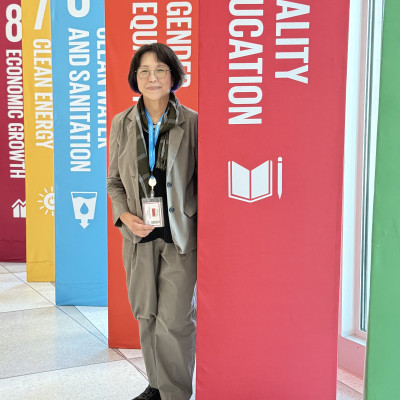
Yuko Ikuta is a professor of sociolinguistics at the Faculty of International Studies, Bunkyo University, Japan. Her research in applied linguistics examines English as a Lingua Franca (ELF), multilingualism, and the development of teacher identity through the lens of trans-speakerism. She is particularly interested in ELF-aware pedagogy and pedagogical spaces that support intercultural engagement, including pre-service teacher education, Model United Nations (Model U.N.) programs, and COIL (Collaborative Online International Learning). Since 2006, she has coordinated a long-running study tour to the United Nations Headquarters in New York. She holds an M.A. in TESOL and an Ed.M. in Applied Linguistics from Teachers College, Columbia University, and is currently a PhD candidate at UCL Institute of Education.